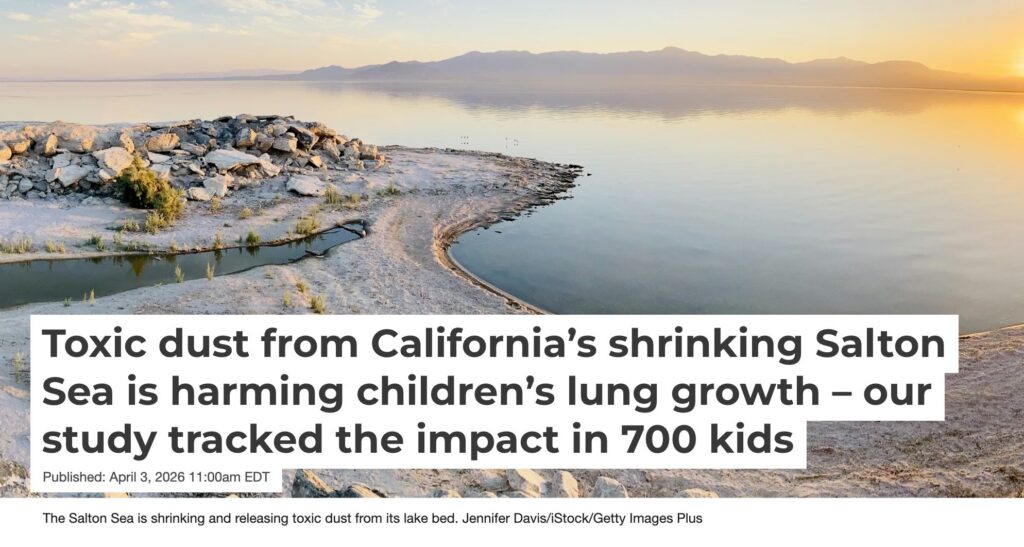
Toxic Dust from California’s Shrinking Salton Sea is Harming Children’s Lung Growth – Our Study Tracked the Impact in 700 Kids

Southern California Center for Children’s Environmental Health Translational Research (SC-CEHRT)
University of Southern California and UC Irvine
On April 3rd, the Los Angeles Times published an article titled “For Water and Mining Policy Near the Salton Sea, Keep in Mind Local Children’s Health” and The Conversation published an article titled, “Toxic Dust from California’s Shrinking Salton Sea is Harming Children’s Lung Growth — Our Study Tracked the Impact in 700 Kids.” Both of these similar pieces were written by Dr. Jill Johnston, Co-Director of SC-CEHRT and Associate Professor in the department of Environmental and Occupational Health at the University of California Irvine, and Dr. Shohreh Farzan, Associate Professor of Population and Public Health Sciences at the University of Southern California’s Keck School of Medicine.
In 2017, Dr. Johnston and Dr. Farzan initiated a cohort study, which followed more than 700 school-aged children in Imperial Valley (a southern California community located near a receding saline lake where nearly one in five children have asthma) for years to document respiratory health symptoms and lung function measurements, as well as household, lifestyle, and behavioral factors. In these articles, Dr. Johnston and Dr. Farzan discuss the results of their study, which has confirmed concerns about high asthma rates and poor respiratory health that community members have been raising for years. They also highlight the need for children’s health to be at the forefront as public and private sectors plan future water changes, extraction projects, and other development near the receding Salton Sea.
To read the articles, click on the light blue links below.